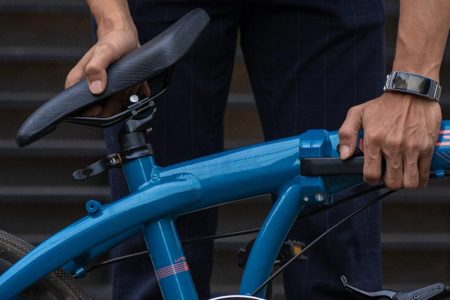




When comparing a folding bike vs city bike, the answer is simple: folding bikes are perfect for short to medium urban commutes, especially if storage and portability matter.
City bikes are better for longer distances, offering more comfort, stability, and smoother rolling efficiency. Your daily mileage and storage situation will determine which one fits your commute best.
How Comfortable Is a Folding Bike for Commuting?
 A folding bike is designed around portability first, then ride comfort. For short to medium urban distances, it performs surprisingly well, especially in dense city environments with frequent stops.
Pros
- Portability and Storage Efficiency: Most folding bikes can be folded within seconds and stored under a desk, inside an apartment, or in tight office spaces. This makes them ideal for commuters with limited storage.
- Better Security: Because you can bring the bike indoors, the risk of theft is significantly reduced compared to locking a bike outside.
- Quick Acceleration: Smaller wheels accelerate quickly from a stop, which works well in stop-and-go traffic conditions.
- Transit Compatibility: Folding bikes are generally easier to bring onto trains or buses compared to full-sized bikes.
Cons
- Ride Stability: Smaller wheels, typically 16 to 20 inches, feel less stable at higher speeds and transmit more road vibration.
- Less Efficient Over Longer Distances: On commutes beyond 10–15 km, maintaining speed requires more effort compared to larger-wheel bikes.
- Hinge Maintenance: The folding mechanism adds moving parts that require periodic inspection and adjustment.
Best For
A folding bike is best for commuters who combine cycling with public transport, live in small apartments, or prioritize indoor storage and security.
How Comfortable Is a City Bike for Commuting?
 A city bike, often referred to as an urban bike, is built for consistent daily riding. Comfort, stability, and practicality are its main strengths.
Pros
- Smoother Ride Quality: With 26-inch or 700c wheels, a city bike rolls over uneven pavement and potholes more smoothly than smaller-wheeled bikes.
- Upright Riding Position: The geometry reduces strain on the lower back, shoulders, and neck, especially over longer distances.
- Cargo Capability: City bikes are designed to support racks, baskets, and fenders, making them practical for carrying work bags or groceries.
- Greater Efficiency: Larger wheels maintain momentum better, which helps on longer commutes.
Cons
- Bulk and Storage Limitations: City bikes require dedicated parking or storage space and are not easy to carry upstairs.
- Higher Theft Exposure: Because they are usually locked outside, security becomes an ongoing consideration.
- Less Transit-friendly: Bringing a full-sized city bike onto public transport is often restricted.
Best For
A city bike is ideal for commuters with direct, door-to-door routes, longer daily distances, and access to secure bike storage.
Folding Bike vs City Bike Comparison
| Feature | Folding Bike | City Bike |
| Storage | Compact; fits in small apartments, under desks, or inside closets | Requires a dedicated parking space, a bike rack, or a larger storage area |
| Portability | High; can be folded in seconds and carried into buildings or public transport | Low; full-size frame makes it difficult to carry or move indoors |
| Security | Higher; usually stored indoors, reducing theft risk | Lower, often locked outside, requires a strong lock and secure parking |
Which One Should You Choose?
If your commute involves multiple transport modes, limited storage, or short urban distances, a folding bike offers unmatched practicality.
If you ride longer distances consistently and prioritize comfort, efficiency, and carrying capacity, a city bike is the better long-term solution.
The decision in the folding bike vs city bike comparison ultimately comes down to distance, storage, and how your daily commute is structured.
Read also:
Read also: