


Choosing the right road bike saddles starts with understanding how your body interacts with the bike. The most important factors usually include your sit bone width, riding flexibility, and the position you maintain while pedaling. From there, details like saddle width, shape, padding, and pressure-relief cutouts help fine-tune comfort.
When these elements match your riding style, a saddle can feel supportive even on long hours in the saddle.
Understand Your Riding Style
Your riding posture plays an important role when choosing road bike saddles. Different riders place pressure on the saddle in different ways depending on their flexibility and riding goals.
In general, riding positions fall into three common categories:
- Aggressive position: Riders who lean far forward often rotate their hips toward the saddle nose. Saddles designed for this style usually allow more movement and help reduce pressure in sensitive areas.
- Neutral position: Many cyclists ride with a balanced posture between upright and aerodynamic. Saddles for this style typically offer moderate support and flexibility.
- Upright endurance position: Riders who sit more upright often prefer saddles with greater rear support to keep the pelvis stable during long rides.
Recognizing your natural riding posture helps narrow down which road bike saddles will feel the most comfortable on your road bike.
Measure Your Sit Bones
Sit bone width is one of the most important factors in saddle comfort. These bones at the base of your pelvis are meant to support your weight on a bike. If a saddle is too narrow, pressure shifts to soft tissue; if it’s too wide, it can cause friction while pedaling.
Many bike shops offer sit bone measurement tools, but simple at-home methods, like sitting on soft cardboard or memory foam, can help estimate the distance. Once you know your measurement, choosing the right width among road bike saddles becomes much easier.
Consider Flexibility and Riding Position
Flexibility plays a big role in how your pelvis rotates while riding. More flexible riders can rotate their hips further forward, while less flexible riders tend to maintain a more upright pelvic position.
This affects which saddle profile works best:
- Flexible riders often feel comfortable on flatter saddles that allow more movement.
- Moderately flexible riders may prefer saddles with a slight curve that balances mobility and stability.
- Less flexible riders usually benefit from saddles with more rear support to keep the pelvis stable.
Matching saddle shape to body flexibility helps distribute pressure more evenly across your sit bones.
Saddle Width and Shape
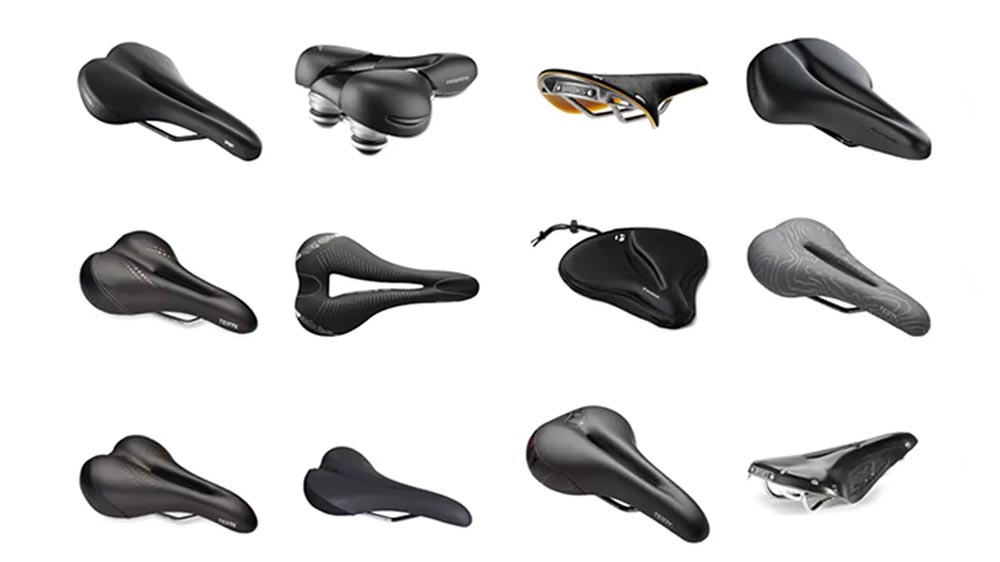 Road bike saddles generally come in several common shapes, each designed for a different riding style.
- Flat saddles have minimal curvature from nose to tail, allowing riders to move freely, ideal for flexible riders and aggressive positions.
- Curved or waved saddles feature a dip in the center and a raised rear section, helping stabilize the pelvis during long rides.
- Short-nose saddles are shorter with a wider rear platform, reducing pressure when riding in a forward aerodynamic position.
- Cut-out saddles include a central channel or hole to relieve pressure and improve comfort on longer rides.
Regardless of shape, choosing the correct saddle width based on your sit bone measurement remains the most important factor.
Padding, Weight, and Materials
Padding can influence how a saddle feels, but more padding does not always mean more comfort.
Very soft saddles may compress during long rides, creating pressure points and friction. Instead, most performance-oriented road bike saddles balance moderate padding with ergonomic shaping.
Materials also affect comfort and performance:
- Foam padding offers a balanced mix of support and durability.
- Gel padding can feel softer initially but may compress over time.
- Carbon rails or shells reduce weight and are often found on high-end saddles used on lightweight builds and race-focused road bike setups.
For long-distance riders, comfort and support usually matter more than minimal weight savings.
Try Before You Commit
 Even after considering riding style, width, and saddle shape, comfort remains highly personal. Two riders with similar setups may prefer completely different road bike saddles.
If possible, test a saddle through a demo program or try different options at a local bike shop. Small adjustments to saddle height, tilt, and fore-aft position can also significantly affect comfort. Sometimes the saddle itself is not the issue; the bike fit simply needs refinement.
Choosing the right road bike saddles is about matching the saddle to your body and riding style rather than simply choosing the softest or lightest option. By understanding sit bone width, flexibility, riding position, and saddle shape, you can find a bike seat that supports your body properly on any road bicycle.
For a deeper look at different saddle models and how they fit various riding styles, you can also read the article “Road bike saddle guide.”
Read also: Road Bike Guidelines 101